
Last updated November 16, 2026
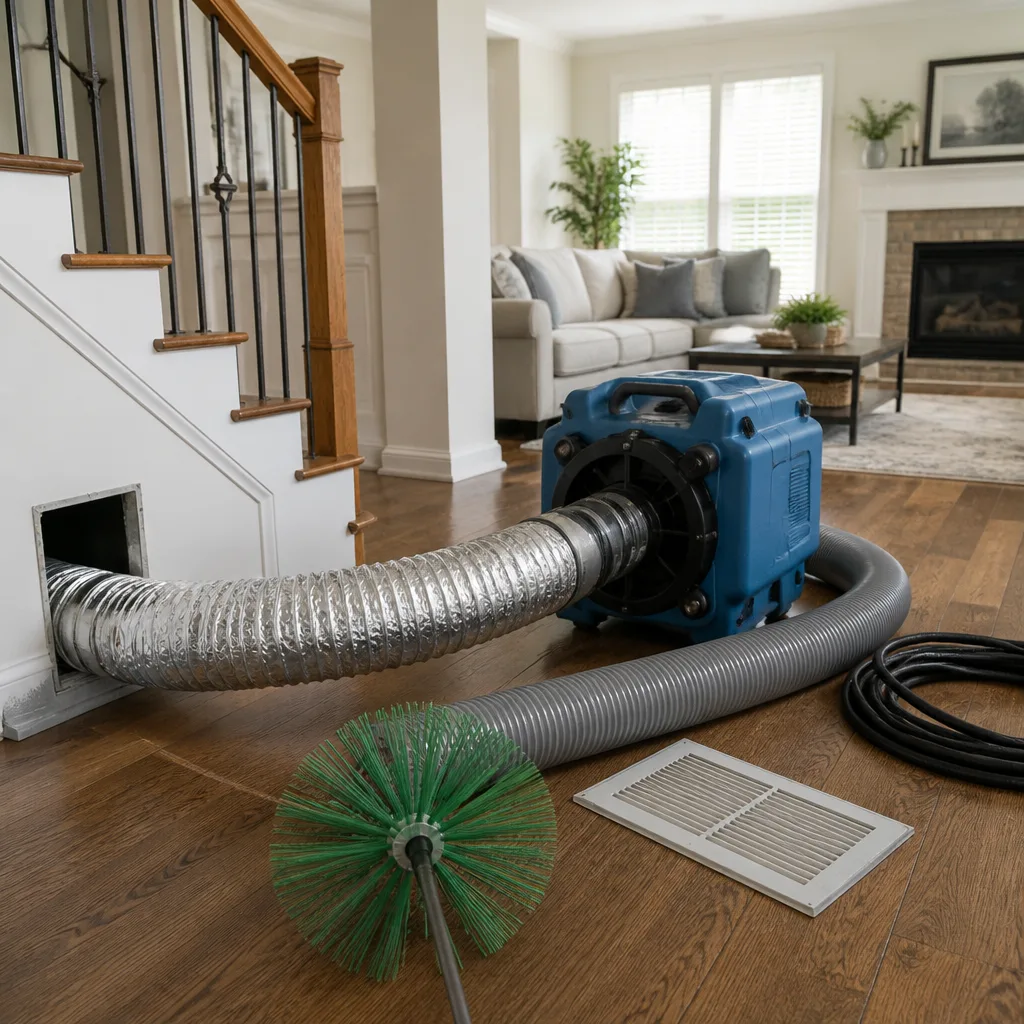 Whole-home duct cleaning
 Dryer vent cleaning
 Camera inspection
 Sanitizing & deodorizing
Whole-system duct and dryer vent check with before-and-after photos - you see exactly what came out of your vents
That "$99 whole-house special" is a bait ad - the real number appears once they are in your hallway, or the "clean" is a shop-vac at the register. We photograph the inside of your ducts before and after instead.
Air Duct Cleaning Permits, Codes & Inspections in South Bend, IN: What You Need to Know
No permit is required to clean your ducts in South Bend. That part is simple. But if a technician also reconnects a separated trunk line, replaces a run of flex duct, or seals a joint with mastic, the regulatory picture can change with the scope of work, and most homeowners have no idea where that line falls. It matters at resale, at insurance time, and when a contractor tells you “it’s just cleaning” while planning repairs you never approved. This guide draws the line between maintenance, repair, and modification, explains how the City of South Bend handles each, and gives you the questions and documents that protect you before work starts.
Quick Answer
Routine cleaning of an existing duct system in South Bend does not require a building permit from the city. Duct work that counts as repair or modification, such as replacing duct sections, altering layout, or reconnecting runs with new materials, may fall under Indiana’s mechanical code framework and South Bend building department review depending on scope. If the work crosses into mold remediation, separate cleanup, containment, and disclosure expectations apply. Before anyone touches your ducts, confirm the scope in writing and ask whether a permit is required for that specific work.
Styles & brands we work with
- Whole-home duct cleaning
- Dryer vent cleaning
- Camera inspection
- Sanitizing & deodorizing
Table of Contents
- Does air duct cleaning require a permit in South Bend?
- How Indiana’s mechanical code treats duct repair vs. replacement
- How South Bend’s building department handles incidental HVAC work
- What to document when repair accompanies cleaning
- Mold in ducts: when cleaning becomes remediation
- Verifying a contractor’s coverage for both cleaning and repair
- What an inspection actually looks like inside your ducts
- Why South Bend’s climate makes duct work matter more
Does air duct cleaning require a permit in South Bend?
Cleaning an existing duct system in South Bend does not require a permit. Cleaning is maintenance: the ducts stay in place, no materials are added to the system’s structure, and nothing about how air moves through your home changes. A permit is generally tied to construction, alteration, or replacement of building systems, not to removing dust and debris from a system that’s already there. If a contractor tells you a permit is needed to simply clean, ask exactly what work they’re planning beyond cleaning.
Where homeowners get confused is that cleaning often happens alongside work that does touch the system’s structure. A crew removing twenty years of pet hair from the supply runs may find a trunk line that pulled apart at a joint. Sealing that joint back together is repair work. Replacing a crushed flex run with new duct is closer to modification. Whether either step crosses a permit threshold depends on scope, and the honest answer is that two jobs can sound nearly identical over the phone but land on different sides of the line. That’s why the written scope matters more than the verbal one.
If you’re scheduling air duct cleaning in South Bend, it helps to ask one question up front: “Is everything you’re planning cleaning, or is any part of it repair?” A straight answer in writing tells you a lot about how the job will be run. Our technicians have up to experience, and in our experience the contractor who separates those two categories clearly is usually the one who handles both well.
How Indiana’s mechanical code treats duct repair vs. replacement
Indiana adopts building codes at the state level, and local jurisdictions like South Bend administer them locally. Mechanical work, which includes duct systems, falls under that framework. The practical distinction the code cares about comes down to whether you’re maintaining an existing system or changing it.
Duct maintenance and cleaning means removing debris, dust, and contaminants from ducts that remain structurally unchanged. No permit in normal circumstances.
Duct repair means restoring a failed component to its original function. Reattaching a disconnected joint, sealing a leak with mastic, or re-supporting a sagging run are typical examples. Whether this needs a permit usually depends on the size and nature of the repair, and often the answer is no for small, like-for-like fixes.
Duct replacement or modification means installing new duct material in place of old, changing the routing or layout, adding or removing supply or return runs, or altering the system’s design capacity. This is where a permit is more often required, because the work changes the system rather than restoring it.
A quick way to think about it:
- Is the duct staying where it is, made of the same material, and just getting sealed or cleaned? That’s maintenance or minor repair.
- Is new duct material going in, or the layout changing? That’s replacement or modification, and a permit is more likely.
- Does the work affect the system’s airflow design, whether a room gets heated or cooled, or how the equipment is served? Treat it as modification and check with the city.
- Is any of this happening in a way that changes the scope beyond what was quoted? Get it in writing before anyone proceeds.
The exact thresholds and code sections are the kind of detail you confirm with South Bend’s building department for your specific job, not the kind of thing you take from a website. We don’t publish code numbers because they change and because your scope is yours, not everyone’s. What doesn’t change: the cost of getting it wrong lands on the homeowner at resale or insurance time.
How South Bend’s building department handles incidental HVAC work
Building departments draw a practical line between incidental repair and system modification. Incidental repair, the kind that happens when a technician opens up a system during maintenance and finds a small failure, is usually handled without a permit because the work restores the system rather than changing it. System modification, where the design, layout, or capacity changes, is where the department wants to see plans.
What this means for South Bend homeowners:
- A disconnected joint found during cleaning and resealed the same visit is typically incidental repair. Document it, but you probably don’t need a permit.
- A crushed or torn flex duct run replaced with new material is a closer call. Sometimes it’s repair, sometimes it’s replacement. The scope and quantity decide it.
- Adding a new supply run to a finished room, altering the duct routing to serve a remodel, or changing the system’s balancing is modification. That’s when you call the building department.
- Duct work done as part of a larger permitted project, such as a remodel or an HVAC changeout, usually rides along on that permit rather than requiring its own.
The city’s review process isn’t designed to make your life harder. It exists so that when the work is done, there’s a record showing it was done to code, by people qualified to do it, with materials that meet standard. That record has real value: it’s the difference between a clean resale and a delayed closing when a buyer’s inspector starts asking about the duct run that doesn’t match the original plans. If you want to know the specific answer for your job, call South Bend’s building department, describe the scope in plain language, and ask. They answer this question regularly, and they’d rather hear from you before the work than after.
What to document when repair accompanies cleaning
Documentation is the single most undervalued part of duct work, and it’s the thing that rescues you at insurance time or resale. A cleaning receipt that says “duct cleaning completed” is nearly useless two years later. A document with scope, materials, and photos is worth the trouble.
Here’s what to ask the contractor to give you when repair work accompanies cleaning:
- A written scope before work starts, listing what will be cleaned and what, if anything, will be repaired or replaced. This is the reference document for everything else.
- Photos of the before condition at the location of any repair, and photos after the repair is complete. Our process uses before-and-after photos of your own ducts precisely because “we cleaned it” isn’t proof of anything.
- A description of materials used, including whether mastic, tape, or new duct sections were installed, and what brand and standard the material meets.
- The contractor’s business name, contact information, and liability coverage confirmation. Ask for a certificate of insurance if repair work is involved.
- A statement of whether a permit was required for the work performed, and if so, whether one was pulled. If not, a line saying no permit was required for this scope is exactly what a buyer’s inspector will want to read.
- Equipment used, especially when the work required HEPA-rated vacuuming or containment. Naming the actual equipment (ours includes Nikro HEPA-rated vacuums and Abatement Technologies containment gear) is the difference between a receipt and a record.
Keep that packet with your home’s other mechanical records. If you ever sell, a buyer’s inspector will look at the furnace, the water heater, and the ducts, and the seller with paperwork wins the question every time. If you own a premium filtration system like Honeywell or Aprilaire, add the cleaning and service records for that equipment to the packet too, because buyers in South Bend do ask about those systems when they’re already installed.
Mold in ducts: when cleaning becomes remediation
Not every dirty duct is a mold problem, and not every mold problem is a remediation job. But when visible mold growth is found inside ductwork, the work crosses from cleaning into a category with its own expectations, and that’s the point where homeowners need to slow down and get the scope right.
The general rule of thumb in the trade is that small areas of surface growth can often be cleaned as part of routine duct work, while larger areas, or growth that returns after cleaning, point to an underlying moisture source that needs to be fixed before anything else. Cleaning mold off a duct without addressing why the moisture is there is like mopping under a running faucet. The moisture usually comes from somewhere specific: a poorly sealed return that’s pulling humid air, a disconnected run, condensation on uninsulated duct in a humid space, or a leak in the system’s surroundings.
In Indiana, remediation work carries its own expectations around containment, cleanup, and disclosure. That’s not a step you want handled informally by a crew that mainly cleans. Standards in the industry exist to define what “remediated” means, and a contractor operating inside those standards will talk about containment before they talk about the price. Our approach uses Abatement Technologies containment equipment so debris and contaminants are captured and controlled during the job rather than loosened and redistributed through the house. If a technician proposes mold work without mentioning containment or moisture correction, that’s your signal to ask harder questions.
If mold is confirmed in your ducts, the sequence that protects you is: identify the moisture source, correct it, then address the growth. Skip the middle step and the growth comes back.
Verifying a contractor’s coverage for both cleaning and repair
Liability coverage for cleaning is not the same as coverage for repair, and asking for proof of both is one of the simplest things you can do to protect your home. Cleaning is a low-risk activity with relatively modest insurance behind it. Repair involves tools, materials, and modifications to a system, and the coverage needs to match. A contractor covered for one but not the other is a problem waiting for a claim.
When you check coverage, ask for these specifics:
- A certificate of insurance showing general liability, sent before work begins, made out to your property address.
- Confirmation the policy covers both duct cleaning and duct repair or modification, not one as an incidental add-on.
- Whether workers are covered for injuries on your property (workers’ compensation or equivalent). You don’t want your homeowner’s policy involved in someone else’s injury.
- Whether the contractor will name you as an additional insured for the duration of the project if the scope is significant. This is more common on larger jobs but worth asking about either way.
If a contractor hesitates to provide a certificate, that’s the answer. Insured and bonded contractors hand these over without a fuss because they’re used to being asked. Anyone who treats the request as an insult is telling you something.
We connect South Bend homeowners with independent local professionals who do this work. When you call, ask for the documentation you need. The good ones will send it before you have to ask twice.
What an inspection actually looks like inside your ducts
A duct inspection isn’t a five-minute peek. It’s a series of checks a trained technician performs to establish what condition the system is in and what, if anything, needs work. Knowing what to expect helps you judge whether the inspection you’re getting is thorough or theater.
A real inspection generally includes:
- Visual review of accessible duct runs, typically at registers and any exposed sections in basements or mechanical rooms.
- Interior viewing with a camera where the duct layout makes it useful, particularly at transitions and long runs where problems hide.
- Checking every connection and joint for separation, especially at trunk-to-branch transitions and where flex duct meets rigid duct. Disconnected joints are the single most common deficiency we find.
- Reviewing the return side as carefully as the supply side, since the return draws contaminants into the system in the first place.
- Looking at the filter and the equipment cabinet for evidence of bypass, moisture, or debris accumulation that points to a duct-side problem.
- Noting any crushed, sagging, or improperly supported flex duct, which restricts airflow and stresses the equipment.
- Documenting what was found with photos, and describing the findings in plain language with a recommended scope.
What the inspection turns up often surprises homeowners. Crushed duct in a crowded basement ceiling, a return that’s pulling air from a crawlspace it shouldn’t, a flex run that was never properly supported. Those aren’t cleaning issues. They’re repair issues, and they need to be named as such. Our position on this is simple: we clean it, and if it’s broken, we fix it. A contractor who only cleans will refer you elsewhere when they find a repair, and that means a second call and a second story to reconcile when something goes wrong.
A good inspection report gives you a basis for decisions, not a pressure pitch. If a technician can’t tell you what they found and where they found it, the inspection was a formality.
Why South Bend’s climate makes duct work matter more
South Bend sits in northern Indiana where winters run long and cold and summers bring genuine humidity. That combination works duct systems harder than a milder climate would. During heating season, the system runs for months on end, and every loose joint and dirty run is cycling air through the house continuously. During air conditioning season, the same system handles moisture control, and any duct deficiency that lets humid air enter the system turns into condensation on cold surfaces, which is the beginning of a bigger problem.
Older homes around the city, particularly in neighborhoods like the Near Northwest and River Park, often have duct systems that predate the equipment now hooked up to them, or have been modified piecemeal over the years. It’s common to find a mix of rigid and flex duct, undersized returns, and joints that were sealed with the wrong tape at some point along the way. None of that is unusual for older housing stock, but it means inspections in these homes need to be more than cursory. If you’re new to a home in these neighborhoods, a baseline inspection and cleaning make sense before you commit to any larger HVAC project.
Winter also drives the other duct-related service we take seriously: dryer vent cleaning. Lint accumulation in a dryer vent is a fire risk year-round, but when a home is buttoned up for months and the dryer is running more often, the buildup happens faster. If it’s been a while since yours was cleaned, that’s a separate call worth making.
If you’re searching for South Bend duct service, know that the local climate actively rewards good duct condition and punishes neglect. The difference between a sealed system and a leaky one shows up in heating bills and indoor air quality through every season.
Common Mistakes to Avoid
- Treating the oral quote as the scope. “We’ll clean everything and fix any issues” is not a scope. Get cleaning and repair listed separately in writing, with prices attached to each, before you approve anything. That single document is the foundation of your insurance and resale record.
- Not asking whether a permit is required. The answer is often no, but you should hear it from the contractor and be able to reconcile it with a call to South Bend’s building department if the scope is significant. Silence on the permit question is not the same as confirmation.
- Accepting a cleaning receipt as documentation. A receipt that says “duct cleaning completed” won’t help you at resale or when an insurance claim surfaces. Ask for scope, materials, before-and-after photos, and equipment used.
- Letting repair work happen without separate approval. A technician who finds a disconnected joint mid-job and fixes it is doing you a favor. But that fix should appear as a documented, separate scope item, not an unexplained charge on the final invoice. A flat price per system, agreed before work starts, avoids this entirely.
- Skipping the moisture question on mold work. If mold is found in your ducts, cleaning without identifying and correcting the moisture source means it returns. Insist on the full sequence: moisture source, correction, then remediation.
- Confirming coverage for cleaning only. If repair is part of the scope, ask for a certificate of insurance that specifically covers it. Homeowners in older South Bend neighborhoods deal with this often because their systems have more repair findings.
- Hiring the crew that shows up with a shop vac. Consumer-grade vacuums loosen debris without containing it. Professional equipment like Nikro HEPA-rated vacuums and Abatement Technologies containment gear captures contaminants during the job. Ask what will be used on yours.
See the difference
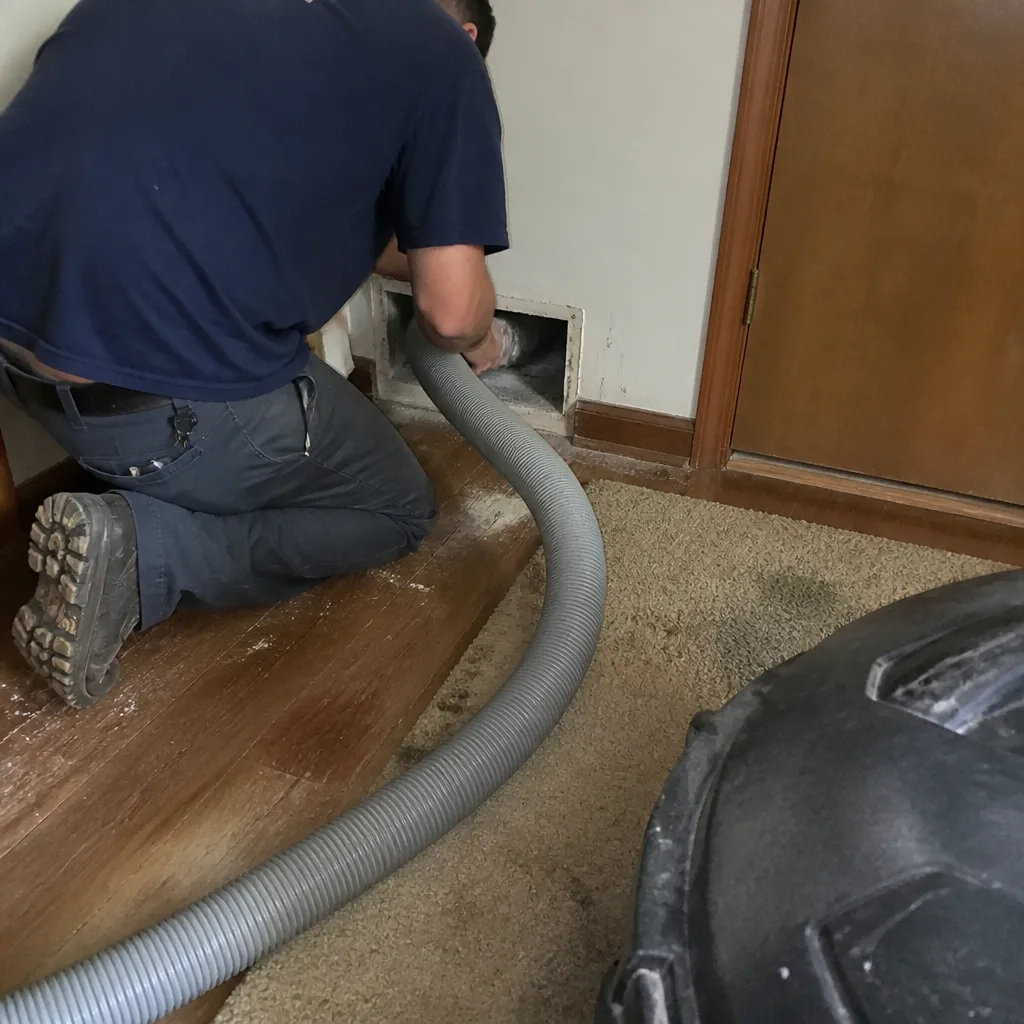 Before
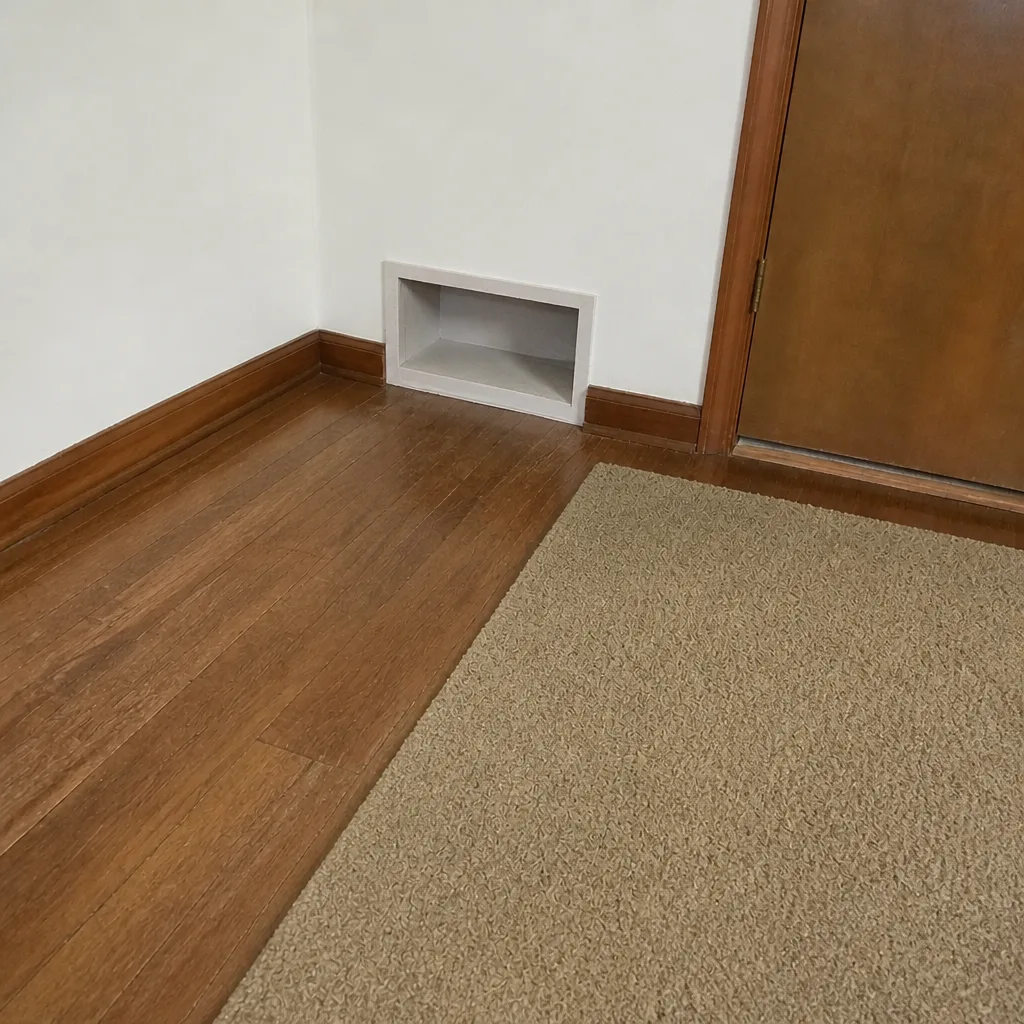 After
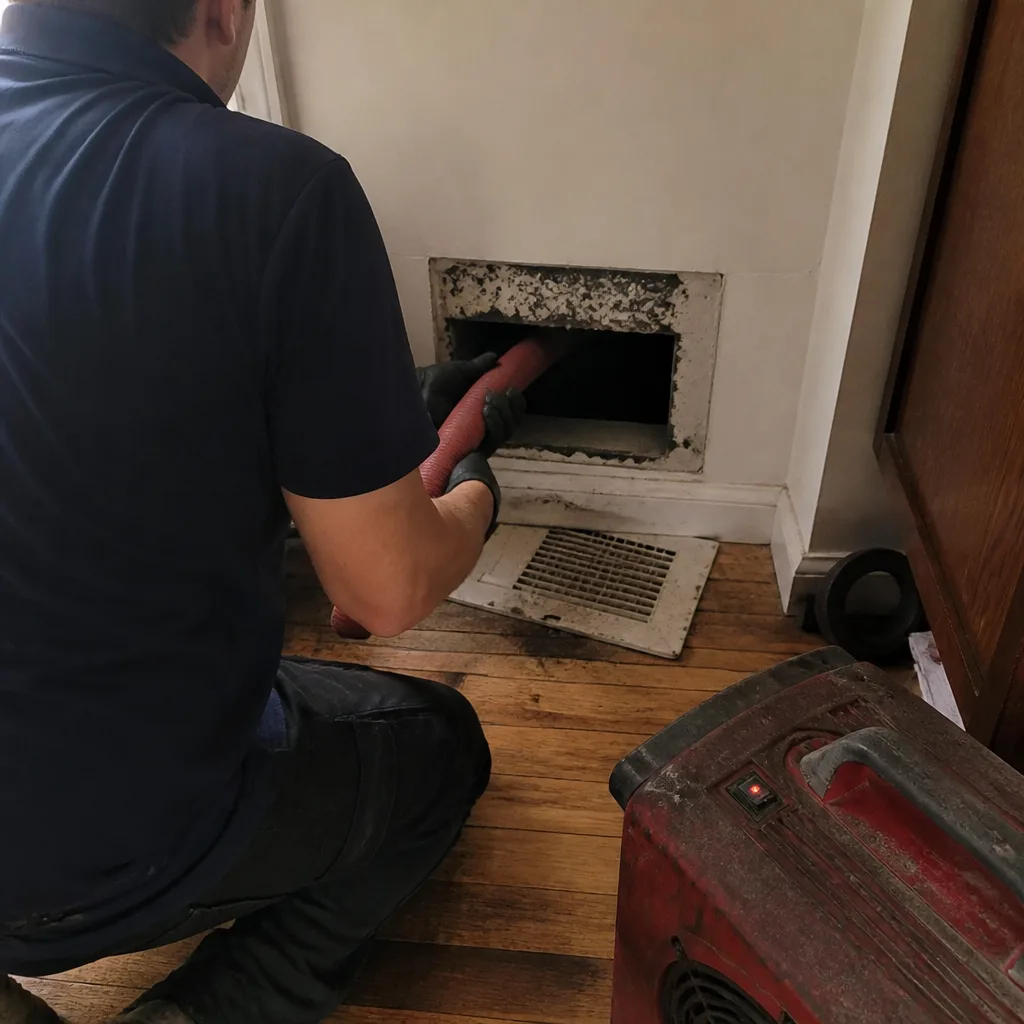 Before
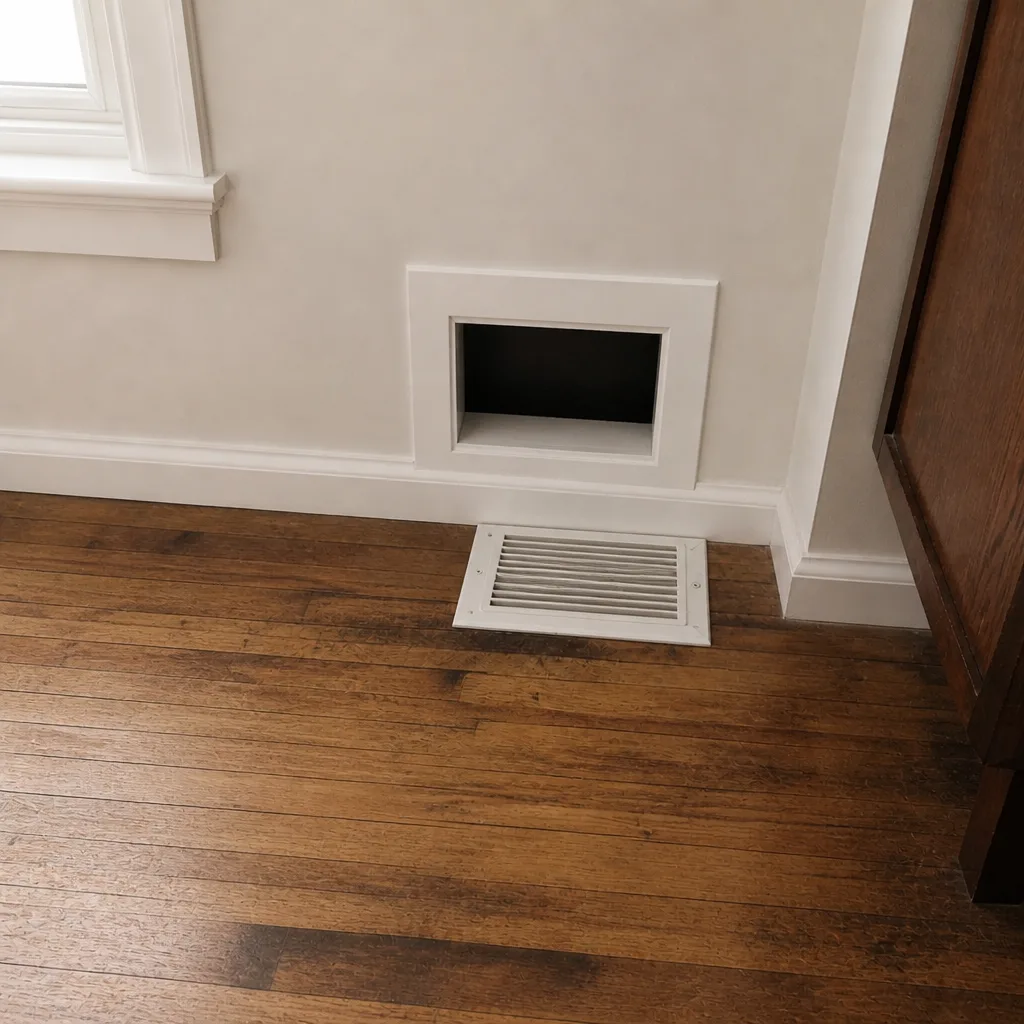 After
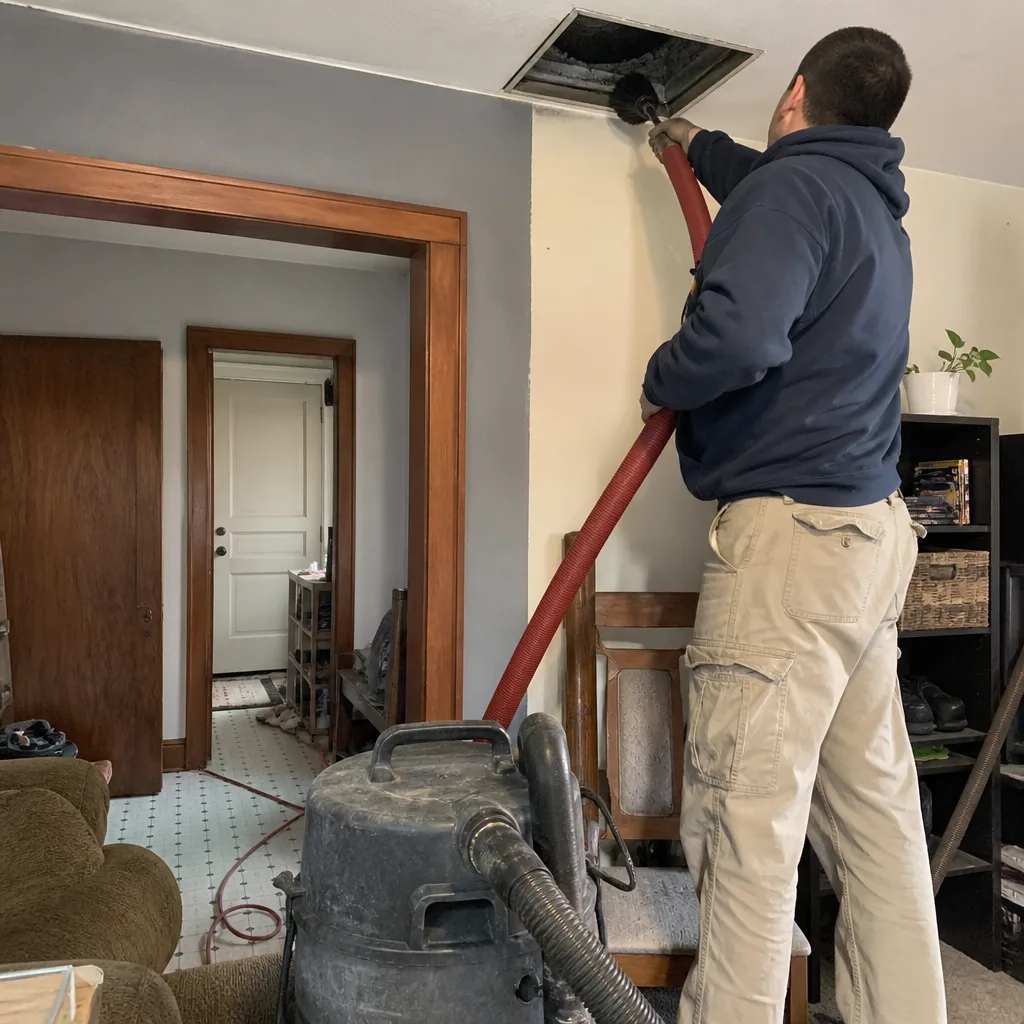 Before
 After
When to Call a Professional
Call a professional when you notice worsening allergy symptoms indoors that improve when you leave, when you can see visible dust streaming from registers after the heat or AC kicks on, or when you buy a home in South Bend and don’t have a record of when the ducts were last serviced. Call when you smell mustiness that doesn’t fade after cleaning the rest of the house, and call if you can see mold at any register. Call if your utility bills have crept up without an obvious reason, or if a technician has told you a duct is crushed or disconnected and you need it fixed rather than referred out. Duct Cleaning South Bend offers free estimates in South Bend; call (855) 905-0868. We answer 24/7. Fast dispatch from 7am to 7pm, Sunday through Friday. If you’d rather read up on the basics before calling, our duct cleaning in South Bend main page covers what’s included in a standard job.
Frequently Asked Questions
No. Cleaning an existing duct system in South Bend doesn’t require a permit because it’s maintenance work that doesn’t alter the system’s structure or design. If the job expands to include repair, replacement, or modification, ask specifically whether a permit is required for that scope. When in doubt, call South Bend’s building department and describe the work.
Yes, at least in how the work is categorized. Cleaning is maintenance. Repair restores a failed component to function. Replacement or modification changes the system’s materials, layout, or capacity. Small like-for-like repairs often don’t require a permit, while replacement or modification work is more likely to be reviewed. The exact threshold depends on scope, so ask the contractor and, if needed, the city.
Ask for a written scope before work starts, before-and-after photos of the specific repair location, a materials description, a certificate of insurance covering both cleaning and repair, and a written statement about whether a permit was required for the work performed. Keep that packet with your home’s maintenance records. It’s the foundation of your documentation if you ever sell or file a claim.
When growth is more than small and surface-level, or when it returns after cleaning, the job has crossed into remediation territory. That means identifying and correcting the moisture source first, then handling containment and cleanup to a defined standard. A contractor proposing mold work without discussing containment or moisture correction is skipping the part that makes the work stick.
Incidental repair found during cleaning is often handled without a permit because it’s restoration rather than design change. Larger modifications, adding runs, changing layout, or replacing significant duct sections, can require review. Insist the contractor tell you in writing whether the work is repair or something larger, and confirm with the city when the scope is significant.
It can matter when a claim arises from duct-related damage, and it certainly matters at resale when a buyer’s inspector asks. Proper documentation, a written scope, photos, and a note about permits gives your insurer and any future buyer a clean record. Unpermitted modification work is the kind of thing that surfaces at the worst moment, usually when you’re trying to close a sale.
The Bottom Line
Cleaning your ducts in South Bend doesn’t require a permit. Repair sometimes does. Replacement or modification often does. Mold remediation carries its own expectations around containment and moisture correction. Draw that line clearly with every contractor you talk to, ask for the scope in writing before work starts, insist on documentation that includes photos and materials, and confirm the contractor’s insurance covers both cleaning and repair if any repair is planned. Our technicians work with Rotobrush agitation systems and Nikro HEPA-rated vacuums, use Abatement Technologies containment equipment on every eligible job, and handle duct repair when a cleaning turns up failures. One call covers it, and you’ll have the paperwork to prove it.
Call (855) 905-0868 for a free estimate. We answer 24/7. Fast dispatch from 7am to 7pm, Sunday through Friday.
Written by the team at Duct Cleaning South Bend.